
agentura.

Tag: teams

  • Every agent gets its own email — and they talk to each other

    Every agent gets its own email — and they talk to each other

    A real teammate has a name, an inbox, and a way to reach the people they work with. Agentura agents do too. Each one gets its own email address, they hand work to each other directly, and they keep you in the loop on the channels you already use.

    A single chatbot lives in one box and waits to be spoken to. A team needs to communicate — outward to customers, sideways to colleagues, and upward to you. So we built three kinds of communication into every agent.

    Each agent has its own email address
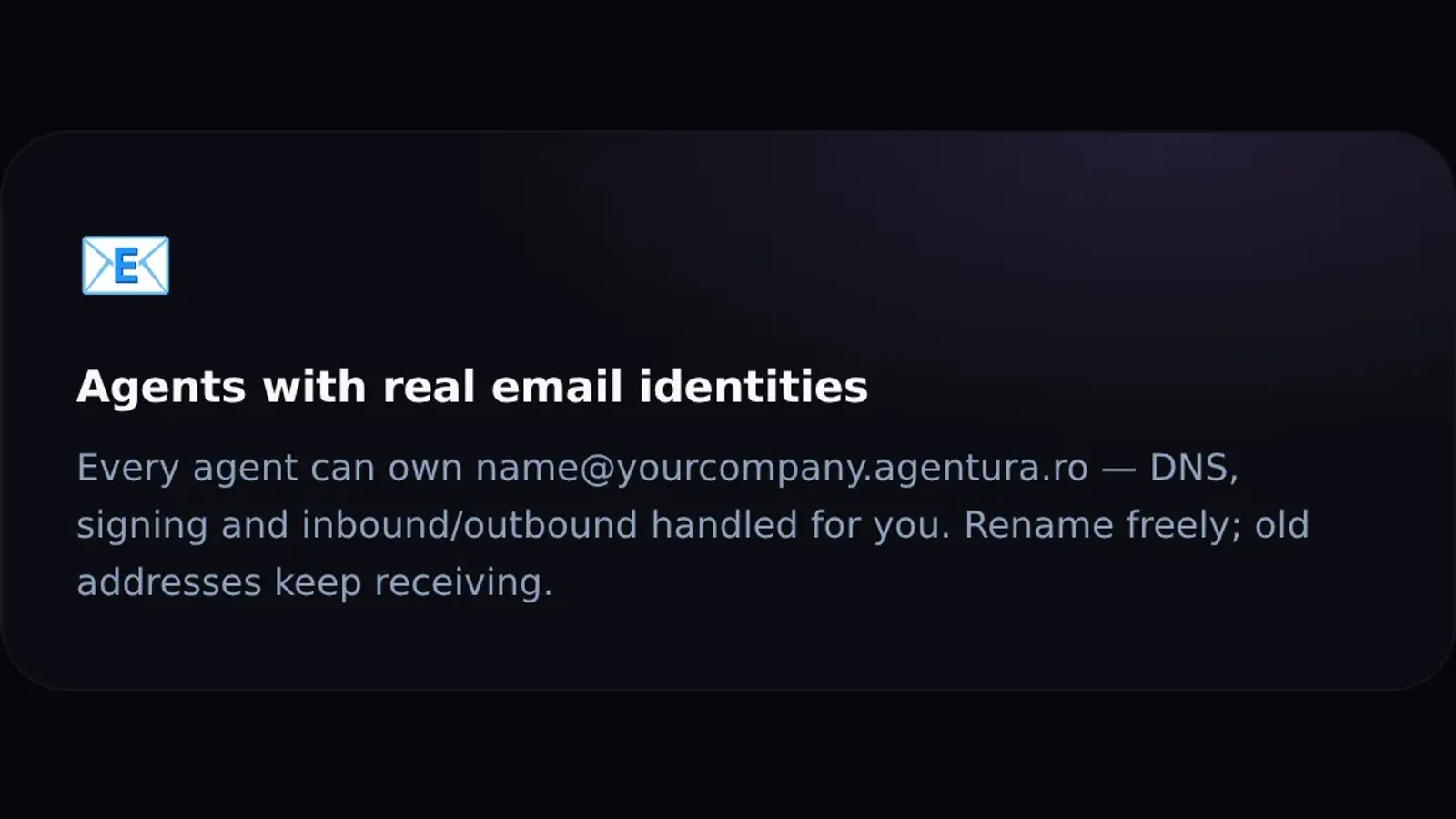
    Agentura feature card: agents with real email identities — name@yourcompany.agentura.ro, DNS and signing handled
    Every agent can own a real, working inbox: [email protected].

    Give an agent an address like [email protected] and it becomes a real, working inbox. The agent reads what arrives and replies from that address — and the unglamorous plumbing is handled for you: DNS records, message signing, and reliable inbound and outbound delivery so messages actually land instead of falling into spam.

    Because the address belongs to the role, not to a person, you can rename an agent freely and its old address keeps receiving — no broken threads, no lost mail. Customers email a department; whichever agent staffs it answers.

    They talk to each other
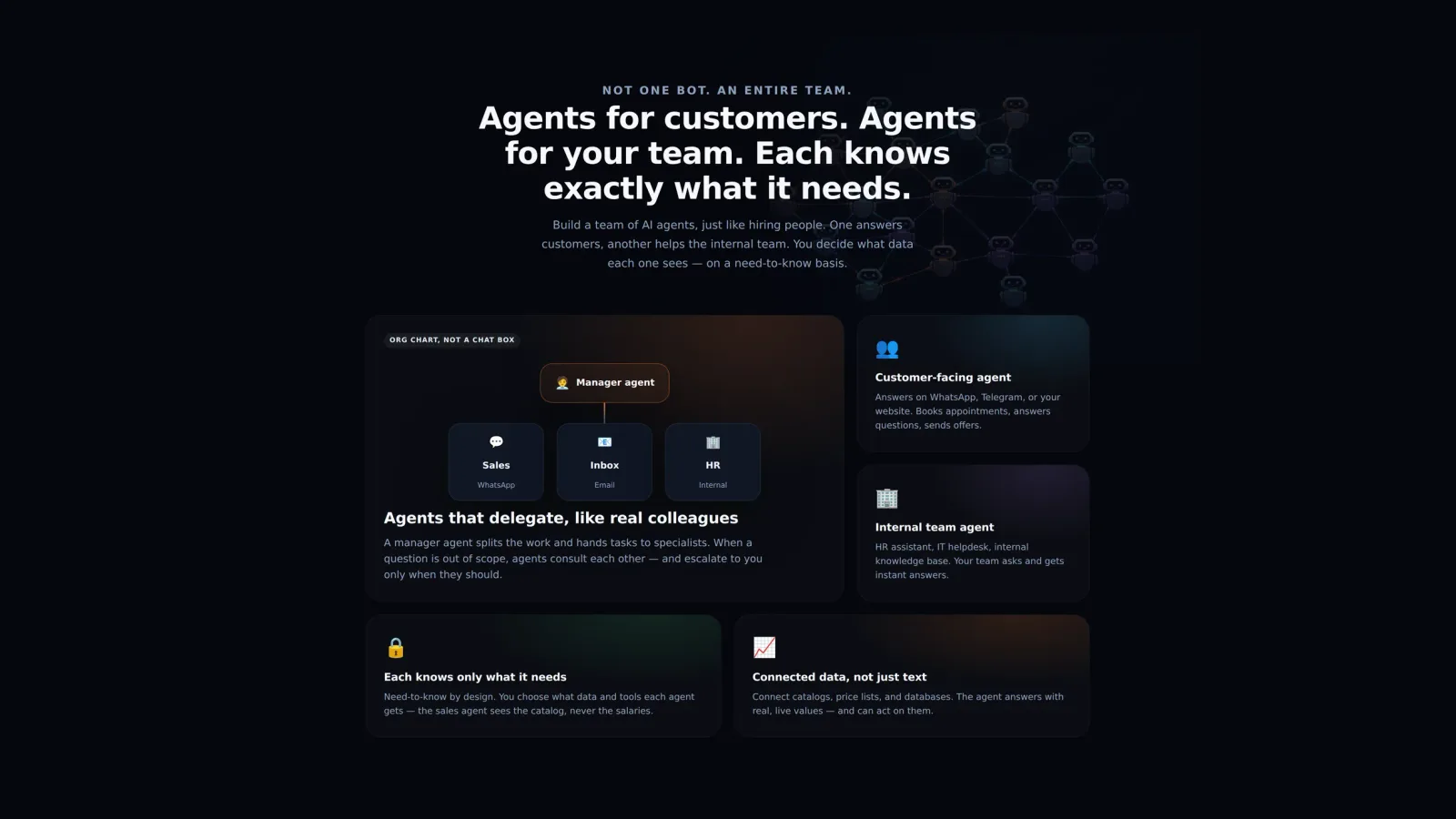
    An org chart of Agentura agents: a manager delegating to sales, inbox and HR specialists
    Agents delegate and consult one another — no human relay in the middle.

    The interesting part is what happens between agents. A manager agent can delegate a task to a specialist and wait for the result. When a question lands outside one agent’s scope, it can consult a colleague instead of guessing or giving up. Work moves down the hall, agent to agent, without a human in the middle copy-pasting between two chat windows.

    This is genuine messaging between agents, not a scripted hand-off — and it’s governed by the same need-to-know rules as everything else. An agent can ask a teammate for help without being handed that teammate’s data or keys.

    Customers get a reply. Colleagues get a hand. You get a heads-up — only when it matters.

    They talk to you

    The third direction is the one you feel most: agents talk to you. They reach you on WhatsApp, Telegram, email, or right in the dashboard — and, crucially, they escalate only when they genuinely should. A capable agent handles the routine itself and pulls you in for the judgment calls, so you hear about the exceptions, not the noise.

    Put the three together — an inbox of their own, a line to each other, and a line to you — and your agents stop behaving like isolated bots and start behaving like a team that communicates. Which is the whole point.

    Give your agents an address →

  • Not one bot — an org chart of AI agents that delegate

    Not one bot — an org chart of AI agents that delegate

    Most “AI for business” tools give you a single chatbot. Agentura gives you something closer to a small company: a team of agents with a manager, specialists, and a clear chain of command — each one knowing exactly what it needs, and nothing more.

    The mental model matters. A lone chatbot has to be a generalist: it answers customers, drafts emails, looks things up, and pretends to know your internal processes — all from one prompt. That breaks down fast. Real organizations don’t work that way, and neither should your agents.

    A manager that splits the work

    In Agentura you build an org chart, not a chat box. A manager agent receives a request, decides who should handle it, and hands the task to the right specialist. When a sales question reaches an agent that’s out of its depth, that agent doesn’t guess — it passes the work to the specialist who owns it, and escalates to a human only when it genuinely should.

    This is real delegation, not a scripted hand-off. The manager can split a multi-part task across several specialists, wait for their results, and assemble the answer. Need temporary capacity for a one-off project? A manager can even spin up a short-lived contractor agent and retire it when the work is done.

    Each agent knows only what it needs

    Delegation is only safe if access is scoped. Agentura is need-to-know by design: you decide what data and which tools each agent receives. The sales agent sees the product catalog and can place orders; it never sees payroll. The HR agent answers internal policy questions; it never touches customer payments. Connectors are scoped per project, so an agent literally cannot reach a system it wasn’t given.

    The sales agent sees the catalog — never the salaries. That’s not a setting you remember to turn on; it’s how the platform is built.

    One dashboard for the whole team

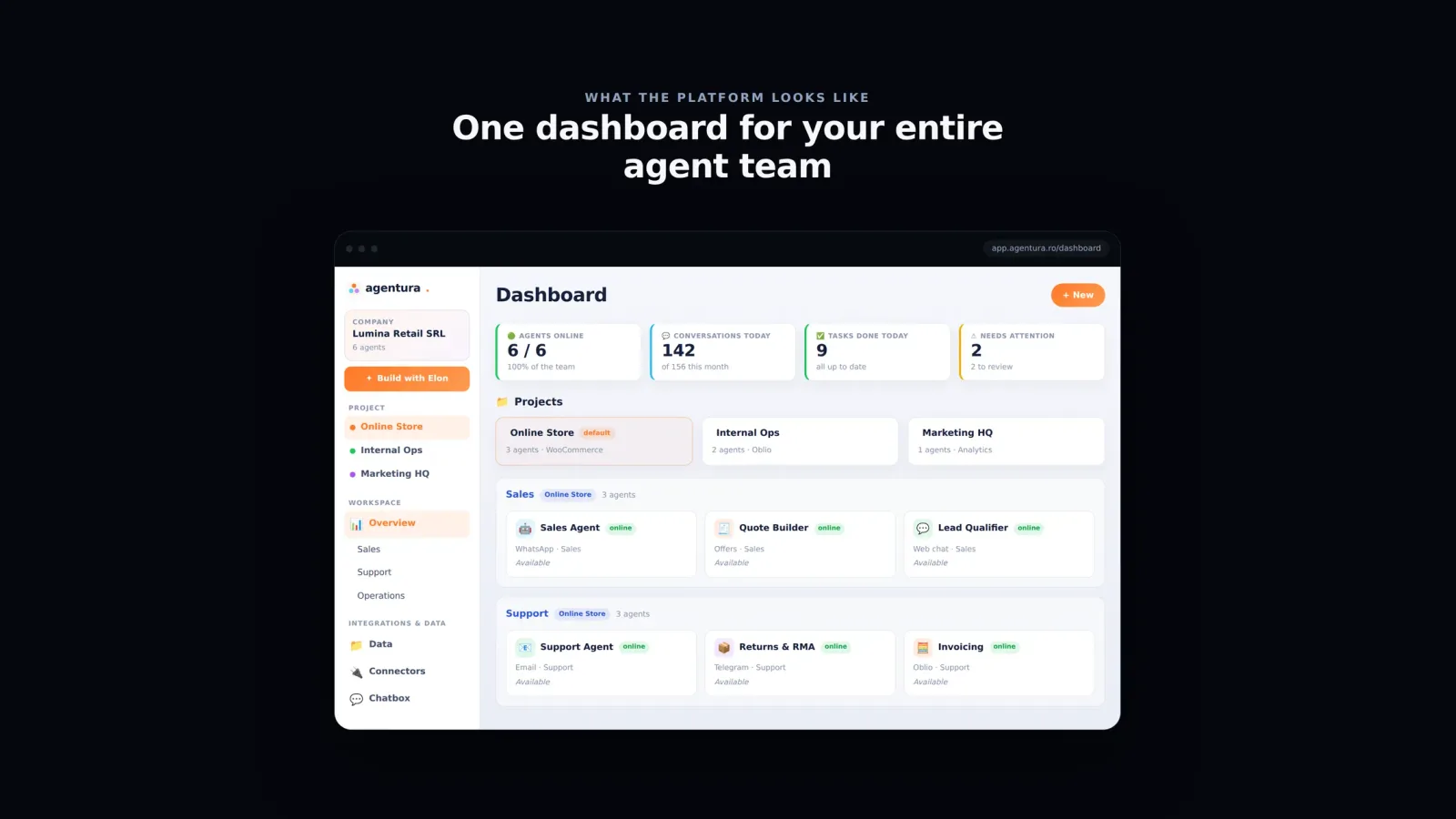
    The Agentura dashboard showing a company with multiple projects and a team of agents, each with a status and role
    Your company, its projects, and every agent’s role and status — in one view.

    Because every agent lives in the same workspace, you get a single dashboard for the entire team: who’s online, the conversations they’re handling, what tasks are done, and what needs your attention. You’re not managing ten disconnected bots — you’re running one team.

    Why this is different

    Plenty of products let you “make a bot.” Very few let you model an organization — with managers, specialists, delegation between them, and per-agent access control enforced by the platform rather than by good intentions. That’s the difference between a clever demo and something you can actually put in front of customers and staff.

    Start with one agent. Add a second when the first one’s plate is full. Before long you’ve built a team that runs itself — and you’re the one delegating.

    Build your team →

  • Projects: structure your agent organisation

    Projects: structure your agent organisation

    A pile of agents isn’t an organisation. Structure is what turns AI into something you can actually run.

    A layer that mirrors how you work

    Agentura organises everything through a clear hierarchy: Company → Project → Team → Agent. It’s the same shape your real business already has. A company runs projects; projects need teams; teams are made of people — or here, agents. Instead of bending your operation to fit the tool, the tool reflects how you actually operate.

    That structure pays off the moment you have more than a couple of agents. You stop thinking about “all my agents” as one undifferentiated blob and start thinking in terms of the work each project owns.

    One active project, in focus

    At any moment, one project is active, and it scopes the things you’re working with: Connectors, Data, Chatbox and CRM. Switch into a project and the platform narrows to exactly that context — the integrations, the records and the conversations that belong to it. No wading through everything at once just to find the one thing you need.

    Focus is a feature. When the active project is the only thing on screen, your team and your tools point the same direction.

    Nothing goes dark when you switch

    Focusing on one project doesn’t mean the others stop. Other projects keep running in the background — their agents are still answering, still working — and anything that needs you shows up as unread badges. You get the calm of a single active workspace without the anxiety of missing what’s happening elsewhere.

    • Active project scopes Connectors, Data, Chatbox and CRM to the work in front of you.
    • Other projects keep running, with unread badges when they need attention.
    • One hierarchy — Company, Project, Team, Agent — that mirrors your real org.

    Logical grouping that scales

    The value here is simple but compounding: as you add agents, the structure keeps them legible. Each project is a self-contained unit of work with its own connectors, data and customer context, and your teams of agents sit neatly inside them. Growing from a handful of agents to a real AI workforce stops being chaos and starts being org design.

    Organise your agents into real projects →