agentura.

Category: Product

  • Every agent gets its own email — and they talk to each other

    Every agent gets its own email — and they talk to each other

    A real teammate has a name, an inbox, and a way to reach the people they work with. Agentura agents do too. Each one gets its own email address, they hand work to each other directly, and they keep you in the loop on the channels you already use.

    A single chatbot lives in one box and waits to be spoken to. A team needs to communicate — outward to customers, sideways to colleagues, and upward to you. So we built three kinds of communication into every agent.

    Each agent has its own email address
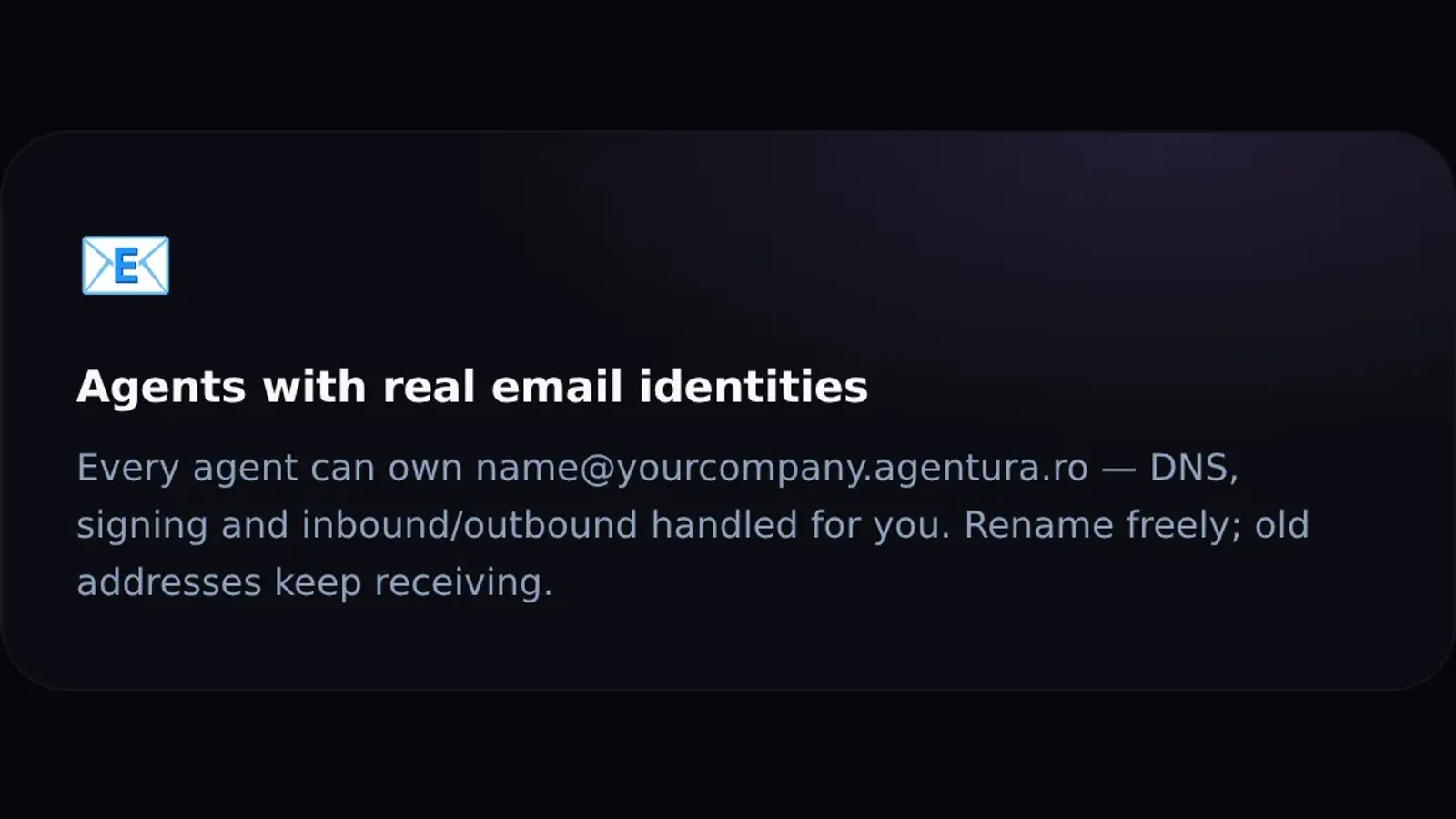
    Agentura feature card: agents with real email identities — name@yourcompany.agentura.ro, DNS and signing handled
    Every agent can own a real, working inbox: [email protected].

    Give an agent an address like [email protected] and it becomes a real, working inbox. The agent reads what arrives and replies from that address — and the unglamorous plumbing is handled for you: DNS records, message signing, and reliable inbound and outbound delivery so messages actually land instead of falling into spam.

    Because the address belongs to the role, not to a person, you can rename an agent freely and its old address keeps receiving — no broken threads, no lost mail. Customers email a department; whichever agent staffs it answers.

    They talk to each other
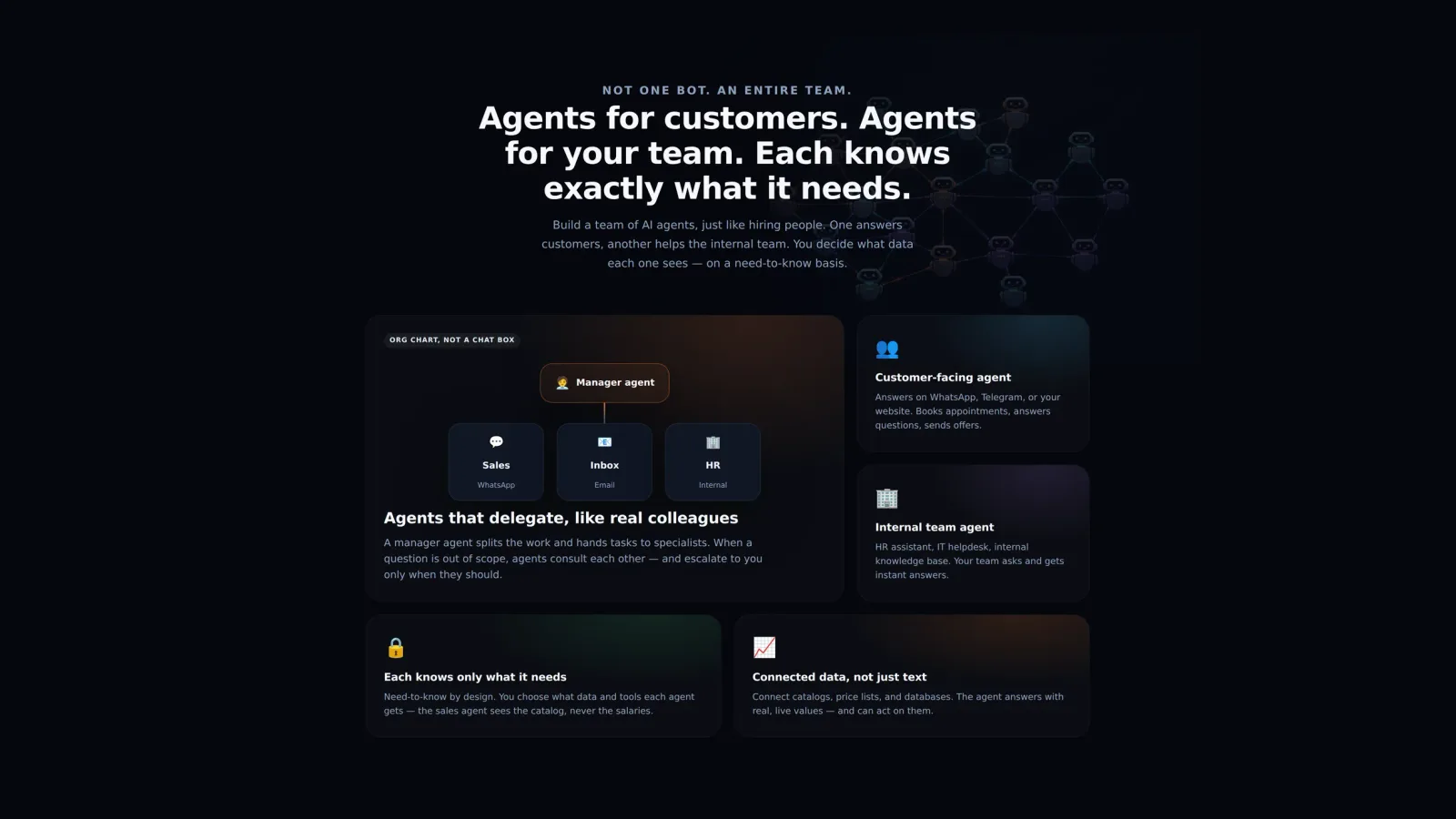
    An org chart of Agentura agents: a manager delegating to sales, inbox and HR specialists
    Agents delegate and consult one another — no human relay in the middle.

    The interesting part is what happens between agents. A manager agent can delegate a task to a specialist and wait for the result. When a question lands outside one agent’s scope, it can consult a colleague instead of guessing or giving up. Work moves down the hall, agent to agent, without a human in the middle copy-pasting between two chat windows.

    This is genuine messaging between agents, not a scripted hand-off — and it’s governed by the same need-to-know rules as everything else. An agent can ask a teammate for help without being handed that teammate’s data or keys.

    Customers get a reply. Colleagues get a hand. You get a heads-up — only when it matters.

    They talk to you

    The third direction is the one you feel most: agents talk to you. They reach you on WhatsApp, Telegram, email, or right in the dashboard — and, crucially, they escalate only when they genuinely should. A capable agent handles the routine itself and pulls you in for the judgment calls, so you hear about the exceptions, not the noise.

    Put the three together — an inbox of their own, a line to each other, and a line to you — and your agents stop behaving like isolated bots and start behaving like a team that communicates. Which is the whole point.

    Give your agents an address →

  • Build your entire AI team in one conversation — meet Elon

    Build your entire AI team in one conversation — meet Elon

    The hardest part of adopting AI isn’t the AI. It’s the blank page. What agents do I even need? How should they be organized? What should each one know? So we made onboarding itself an agent — a CEO-style interviewer that designs your team for you.

    Most tools hand you an empty builder and wish you luck. You’re expected to already know the answer to a question you’ve never had to ask: how do you turn “I run a business” into “here is my AI org”? The empty builder is still there if you want it — but you don’t have to start from a blank canvas. Agentura answers the question with a conversation.

    Onboarding is an agent

    Instead of wiring up a wizard yourself, you can talk to Elon, a CEO-style onboarding agent. It interviews you about your business the way a sharp new operations lead would: what do you sell, who do you serve, where do customers reach you, what slows your team down.

    A CEO-style agent interviews you and proposes your whole team — projects, roles, and the first set of agents — then builds them on your say-so.

    It doesn’t only listen. Elon scouts the public web to understand your company in context, then proposes a minimum viable organization: the projects you need, the teams inside them, and the specific agents to staff them — each with a clear role, and scheduled workflows where they help. Approve it, and the platform provisions the whole structure for you in the background.

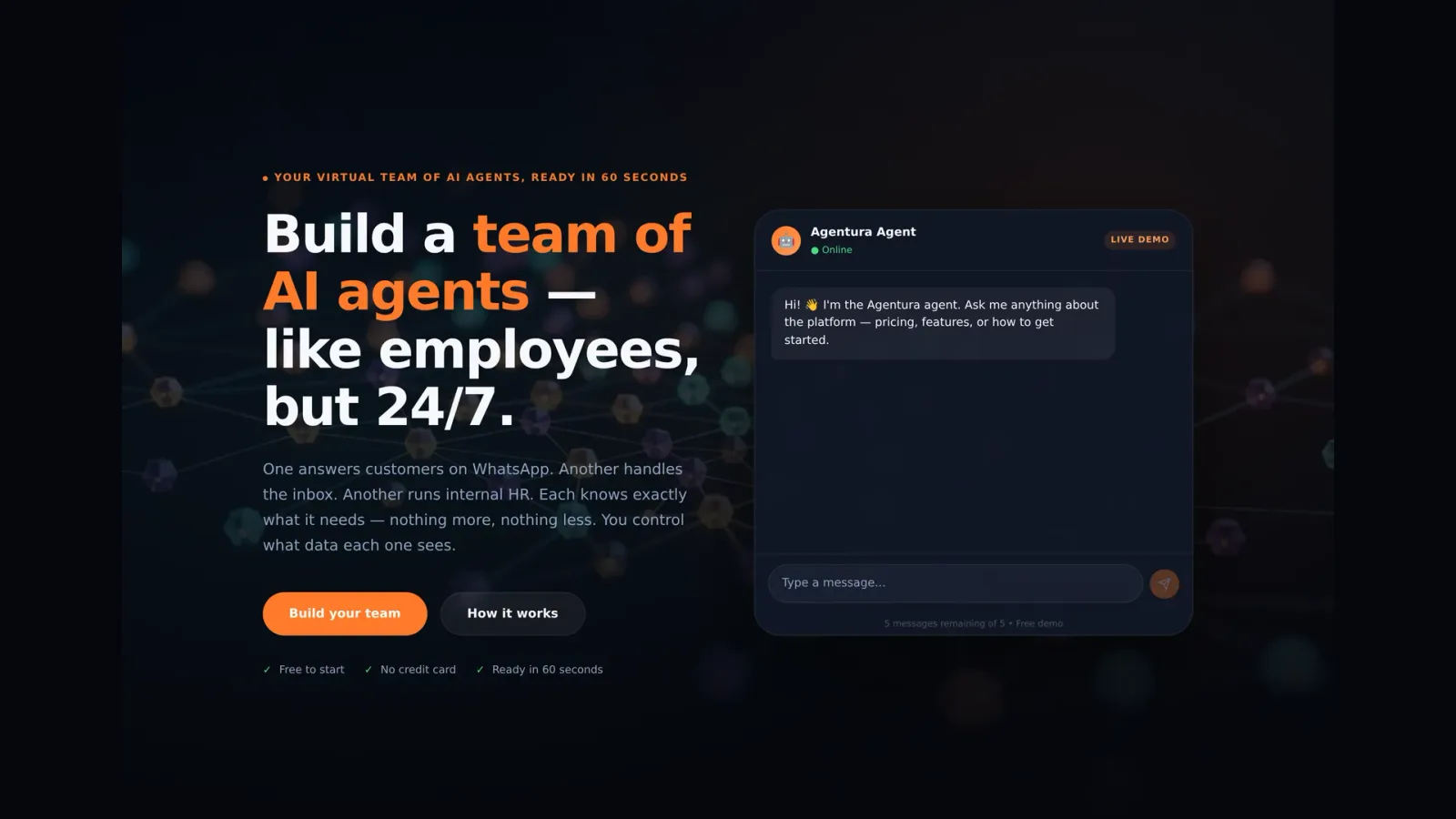
    The Agentura hero with a live demo chat — build a team of AI agents from one conversation
    From a single conversation to a working team — designed in one sitting, then built for you.

    From idea to working team in one sitting

    This collapses what’s normally days of “designing your AI strategy” into a single conversation. Instead of staring at an empty dashboard, you finish onboarding already looking at a sensible structure: a sales agent on your busiest channel, a support agent on email, an internal helper for your team — organized into projects that mirror how you actually operate, with the agents themselves spinning up in the background.

    And nothing is locked in. The org Elon proposes is a starting point you fully own: rename agents, change what each one can see, add specialists, retire ones you don’t need. The point isn’t to decide everything for you — it’s to make sure you never start from zero.

    Why this is the unlock

    The gap between “AI sounds useful” and “AI is doing work for me” is almost always the setup. By turning that setup into a guided conversation with an agent that understands org design, Agentura removes the single biggest reason teams stall before they start. You describe the business; you get the team.

    Build with Elon →

  • Not one bot — an org chart of AI agents that delegate

    Not one bot — an org chart of AI agents that delegate

    Most “AI for business” tools give you a single chatbot. Agentura gives you something closer to a small company: a team of agents with a manager, specialists, and a clear chain of command — each one knowing exactly what it needs, and nothing more.

    The mental model matters. A lone chatbot has to be a generalist: it answers customers, drafts emails, looks things up, and pretends to know your internal processes — all from one prompt. That breaks down fast. Real organizations don’t work that way, and neither should your agents.

    A manager that splits the work

    In Agentura you build an org chart, not a chat box. A manager agent receives a request, decides who should handle it, and hands the task to the right specialist. When a sales question reaches an agent that’s out of its depth, that agent doesn’t guess — it passes the work to the specialist who owns it, and escalates to a human only when it genuinely should.

    This is real delegation, not a scripted hand-off. The manager can split a multi-part task across several specialists, wait for their results, and assemble the answer. Need temporary capacity for a one-off project? A manager can even spin up a short-lived contractor agent and retire it when the work is done.

    Each agent knows only what it needs

    Delegation is only safe if access is scoped. Agentura is need-to-know by design: you decide what data and which tools each agent receives. The sales agent sees the product catalog and can place orders; it never sees payroll. The HR agent answers internal policy questions; it never touches customer payments. Connectors are scoped per project, so an agent literally cannot reach a system it wasn’t given.

    The sales agent sees the catalog — never the salaries. That’s not a setting you remember to turn on; it’s how the platform is built.

    One dashboard for the whole team

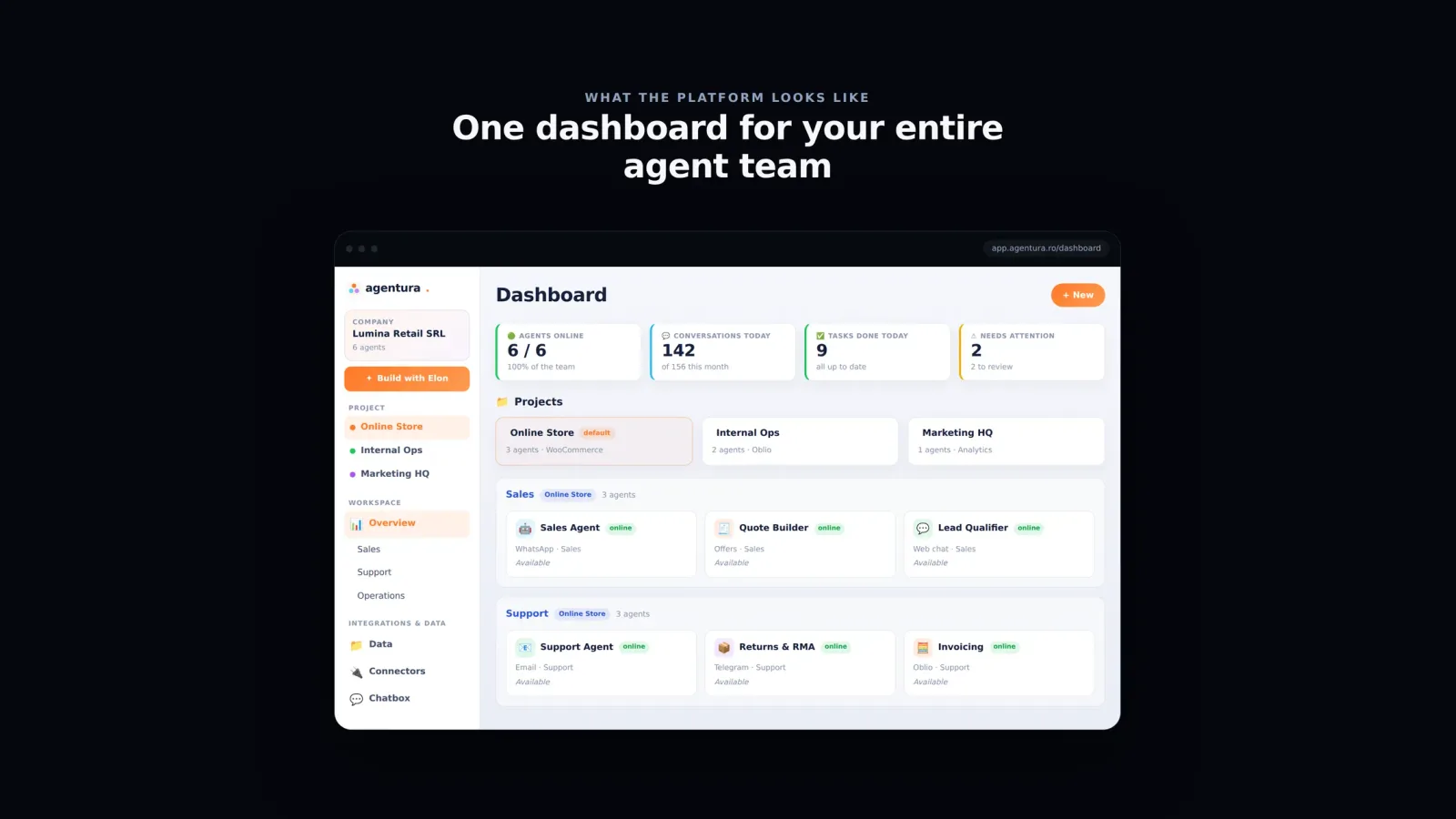
    The Agentura dashboard showing a company with multiple projects and a team of agents, each with a status and role
    Your company, its projects, and every agent’s role and status — in one view.

    Because every agent lives in the same workspace, you get a single dashboard for the entire team: who’s online, the conversations they’re handling, what tasks are done, and what needs your attention. You’re not managing ten disconnected bots — you’re running one team.

    Why this is different

    Plenty of products let you “make a bot.” Very few let you model an organization — with managers, specialists, delegation between them, and per-agent access control enforced by the platform rather than by good intentions. That’s the difference between a clever demo and something you can actually put in front of customers and staff.

    Start with one agent. Add a second when the first one’s plate is full. Before long you’ve built a team that runs itself — and you’re the one delegating.

    Build your team →

  • Watch your AI agent browse the web — live

    Watch your AI agent browse the web — live

    Some tasks don’t live behind a tidy API. They live on a website — a supplier portal, a tracking page, a form that has to be filled in by hand. So we gave Agentura agents a real browser, and put a live mirror in front of it so you can watch them work.

    “The agent can browse the web” usually means it fetched a page and summarized the text. That’s not browsing — that’s reading. Real browsing means clicking, typing, navigating multi-step flows, and dealing with pages that only make sense once they’ve rendered. Agentura agents drive an actual browser to do exactly that.

    Watch it happen, in real time

    The part people remember is the live mirror. When an agent opens the browser, a panel streams what it’s doing as it does it — pages loading, fields being filled, buttons being clicked. It isn’t a screenshot after the fact; it’s a real-time view of the session. You can see the agent’s reasoning turn into action, step by step.

    A real browser the agent drives — and a live mirror so you’re never guessing what it did.

    Three tiers, one capability

    Under the hood there are three complementary modes, so the right one fits the task:

    • Sandbox browsing — the default. A safe, public-web browser the agent uses for research and routine navigation, mirrored live to your screen.
    • Your own device — for sites that need your login. Pair and approve a device, and the agent drives a browser on your machine, inside sessions you’re already signed in to — so logins stay where they belong, on your device.
    • Co-browsing — the agent can build and serve an interactive page you step through together, turning a lookup into a shared workflow.
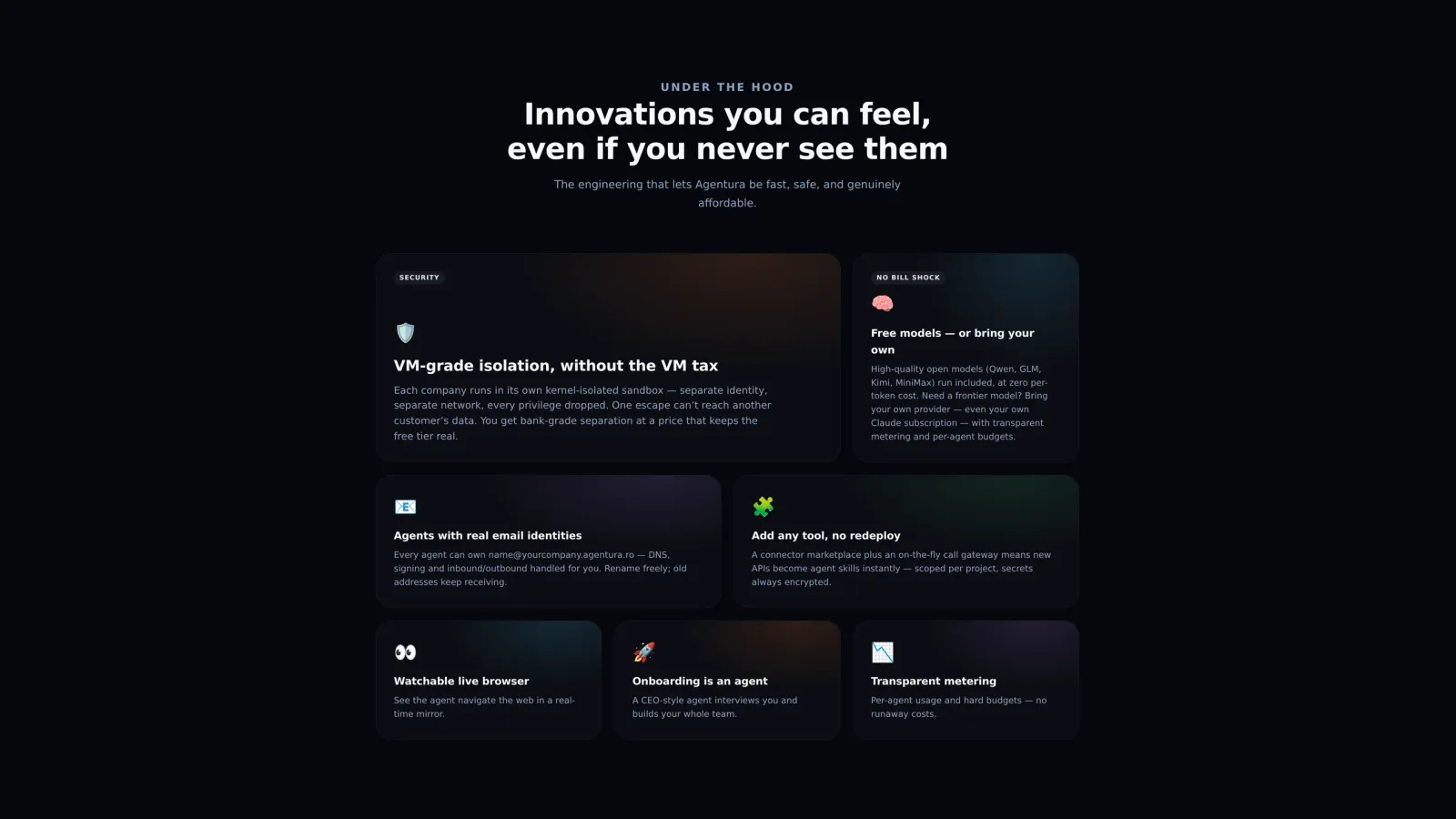
    Agentura innovations grid highlighting a watchable live browser, real email identities, and onboarding-as-an-agent
    The live browser is one of several capabilities designed to be felt, not just listed.

    Why a live view changes the trust equation

    Autonomy is only useful if you trust it, and trust comes from transparency. A black-box agent that “handled it” leaves you wondering what it actually did. A watchable browser removes the doubt: you can glance at the mirror, confirm it’s on the right page doing the right thing, and step in if needed. It’s the difference between hoping and knowing.

    The web wasn’t built for machines, but most of your day still happens there. Now an agent can navigate it the way you would — and let you watch over its shoulder.

    See it in action →

  • Real connectors: agents that act, not just chat

    Real connectors: agents that act, not just chat

    An agent that can only talk is a fancy FAQ. The interesting part starts when it can act — place the order, issue the invoice, mark it paid, read the file, generate the image, run the code. That’s what connectors are for.

    Conversation is the easy half. The half that actually moves your business forward is the part where something happens in a real system afterwards. Agentura agents are built to do the work, not just describe it.

    Real systems, real actions

    Connect your accounts and an agent can place WooCommerce orders and mark them paid, issue invoices through Oblio and SmartBill, raise and track PayPal invoices, read your Google Drive, send email from a real address, generate images, and run code. These aren’t canned integrations bolted onto a chat window — they’re tools the agent decides to use, in the middle of solving a problem, the same way a capable employee would.

    Because connectors are multi-instance and project-scoped, the same agent platform can serve a shop, an internal ops team, and a marketing project — each wired to its own accounts, none of them able to reach the others’.

    The model never sees your secrets

    Here’s the detail that matters most and gets talked about least: credentials stay encrypted, and the language model never sees them.

    API keys and passwords are stored encrypted and injected at the network edge, on the way to the real service. The agent calls a tool by name; it never holds the key.

    When an agent uses a connector, the request is routed through a proxy that attaches the right encrypted credential just before it reaches the external service. The key is never placed in the prompt, never returned in a response, and never exposed to the model. So even a cleverly manipulated agent has nothing to leak — there’s no secret in its context to begin with.

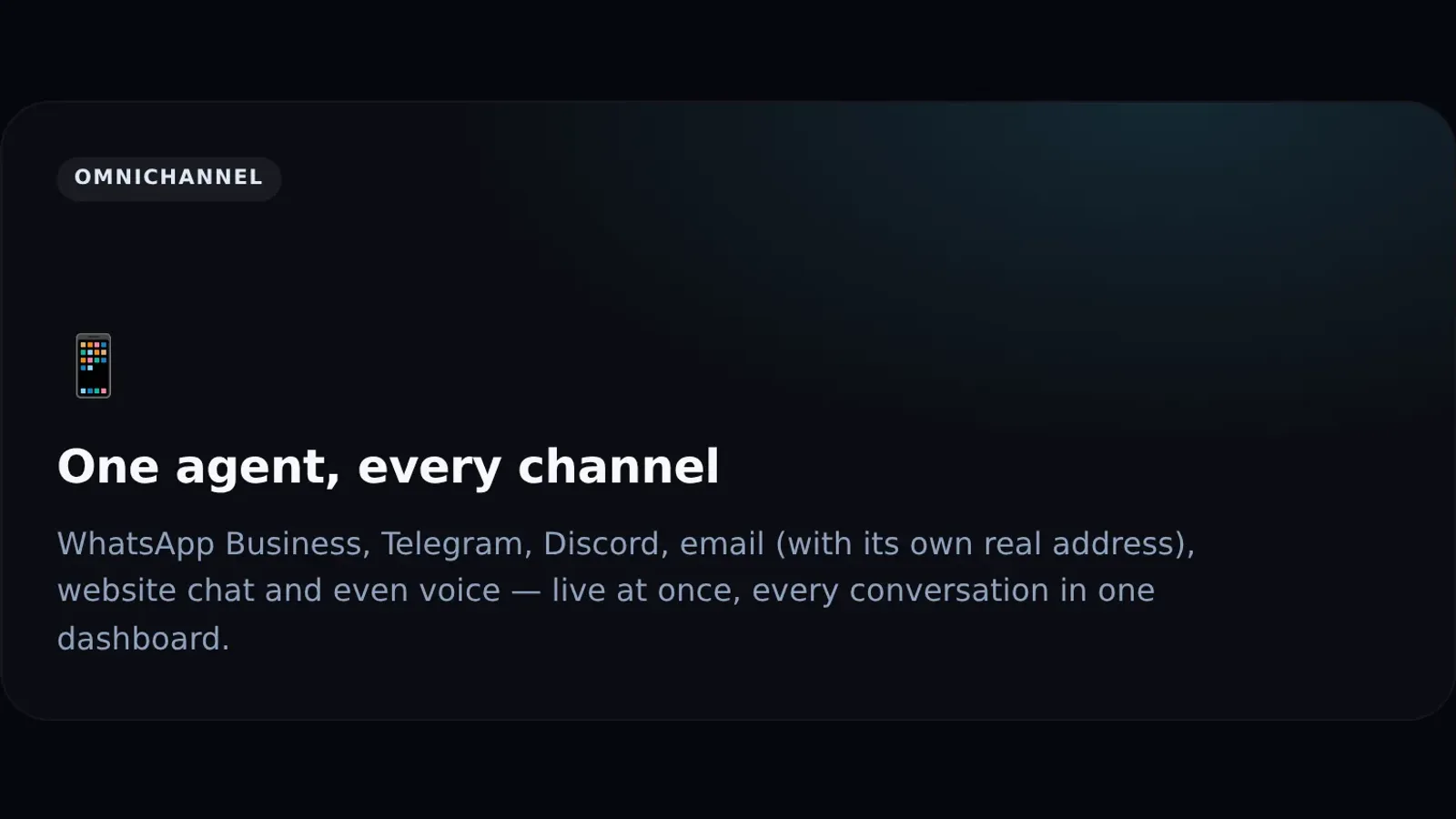
    An Agentura feature card describing one agent working across WhatsApp, Telegram, email, website chat and voice
    The same agent acts across every channel — and reaches the tools behind them.

    Add any tool — no redeploy

    Most platforms make “add an integration” a development project. Agentura treats connectors as a marketplace plus an on-the-fly gateway: the connectors above are free to switch on — you add one from the marketplace, drop in its credentials once, and its tools become agent skills almost immediately, scoped to the project that needs them, with secrets always encrypted. Running code is enabled from the start. You’re not waiting on a release to give an agent a new capability.

    The result is an agent that closes the loop. A customer asks for an invoice and gets a real one. A lead wants to order and the order is placed and marked paid. A teammate needs a document and it’s pulled from Drive. Less “here’s how you could do that,” more “done.”

    Connect your tools →

  • Memory, knowledge, and a proactive heartbeat

    Memory, knowledge, and a proactive heartbeat

    A useful colleague remembers your last conversation, knows where the documents are, and gets things moving without being asked twice. Agentura agents are built the same way: persistent memory, real knowledge retrieval, and a proactive heartbeat that lets them act between messages — not just react to them.

    Two things separate a tool you have to babysit from a teammate you can rely on: it remembers, and it takes initiative. Most chatbots do neither. They forget you the moment the tab closes, and they never do anything unless poked. Agentura was designed to fix both.

    Memory that carries across conversations

    Agentura agents keep persistent memory. They remember customers, decisions, and context across conversations — so a returning customer isn’t starting from scratch, and an internal agent recalls what was agreed last week. Over time an agent builds up its own working knowledge: notes to itself, runbooks for recurring tasks, the small facts that make answers feel informed rather than generic — kept always to hand in its memory so they’re there on every turn.

    Knowledge it can actually retrieve

    Upload files, URLs, and documents, and they become part of what your agent can draw on — turned into a readable knowledge file and indexed for search within seconds of the upload. When the answer lives in your material, the agent looks it up and pulls the relevant passage instead of guessing, and it can search back through its own past conversations the same way. Retrieval is on demand and semantic, so the agent reaches for what’s relevant to the task at hand rather than drowning in everything at once.

    It remembers customers and decisions across conversations — and when the answer is in your documents, it looks it up rather than inventing one.

    A proactive heartbeat

    The piece that surprises people most: agents don’t only wait for you. A built-in heartbeat wakes each agent on a schedule to do real proactive work — check on open orders and tasks, follow up where a follow-up is overdue, surface something that needs your attention. It’s the difference between an assistant that answers when spoken to and one that notices a problem before you do.

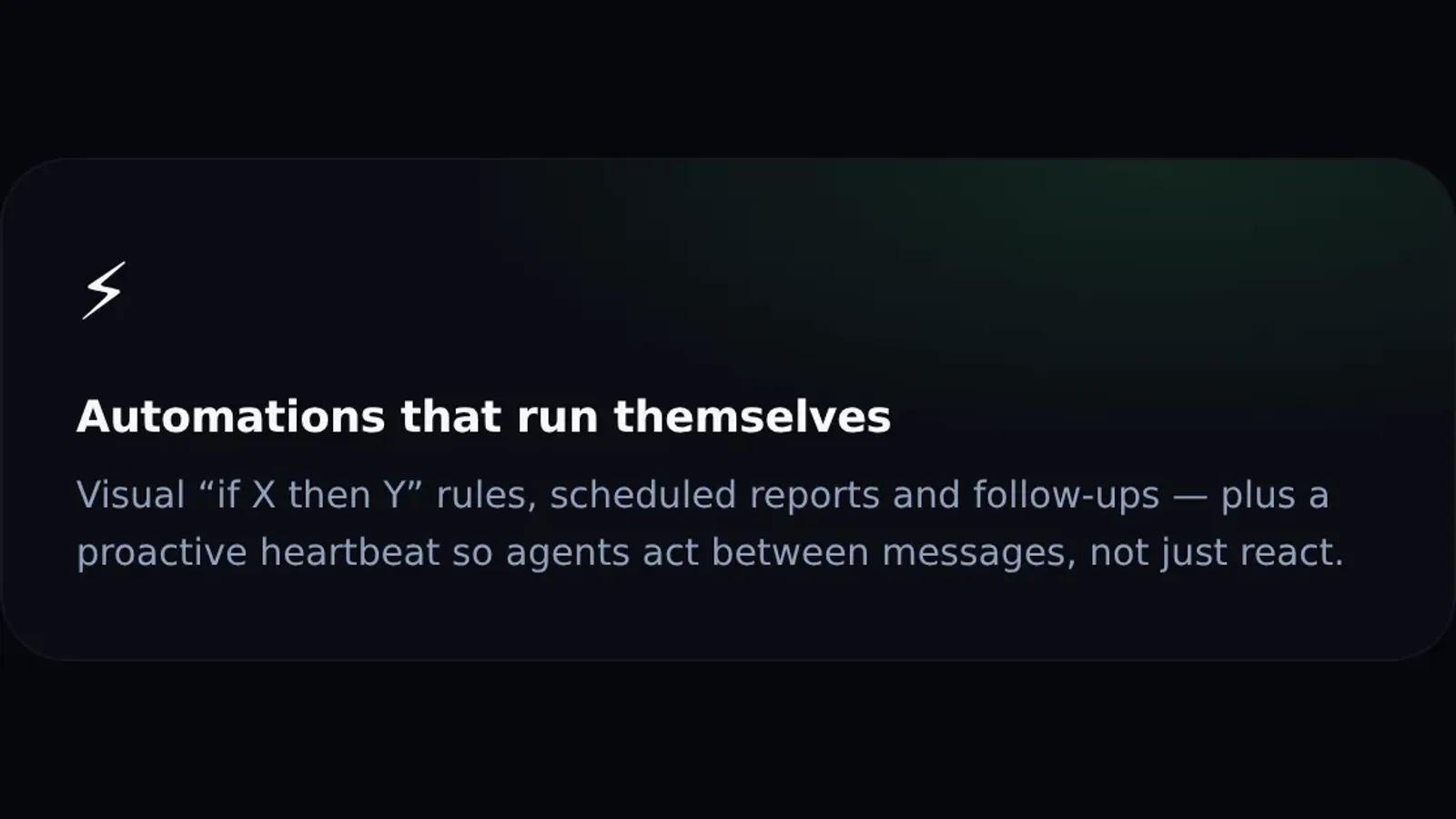
    Agentura feature card describing automations: visual if-X-then-Y rules, scheduled reports, and a proactive heartbeat
    Visual “if X then Y” rules, scheduled reports, and a heartbeat that keeps agents working between messages.

    Automations on top

    For the patterns you want to make explicit, there are automations: visual “if X then Y” rules, scheduled reports, and recurring follow-ups. Combine that with the heartbeat and your agents stop being a place you go to ask questions and start being something that quietly keeps your operation moving — sending the report, chasing the open ticket, flagging the exception.

    Memory makes an agent feel like it knows you. Knowledge makes it accurate. The heartbeat makes it proactive. Together, they turn a chat window into a coworker.

    Put an agent to work →